

 Cart is empty
Navratri begins on the day of Ghatsthapana. The festival of Navratri is a symbol of woman power. We are celebrating it. The festival is celebrated differently in different parts of India. Someone puts a pot and worships it. The nine garlands symbolize the nine forms of the Goddess and the nine days. In some places, garba is played in front of the goddess, fasting is done, in some places large idols are installed, conch shells are blown. But in ancient times, even the nine forms of this goddess had some meaning, these forms were not created by chance. In the interim, due to many attacks on India, the important subject of it was left behind, only Devi worship, celebration became important. The Goddess is worshipped with nine different identities which symbolizes different powers and importance. 1. Shailputri 2. Brahmacharini 3. Chandraghanta 4. Kushmanda 5. Skandamata 6. Katyani 7. Kalaratri 8. Mahagauri 9. Siddhidatri. Theses forms of Goddess are completely associated with nine medicines. These nine medicines (which are used in every medicine preferably in Ayurveda) have a very important place in the health of women. Women’s health is very important in Indian culture and Ayurveda too. The woman is the primordial deity and the creation was born from her. As a symbol of this, during Navratri, a ghat (womb of women is considered as ghat) is installed and grains are sown below; it is new in this season. Ankur means the symbol of anticipatory creativity, the ability to create others like you, which is natural to a woman. Therefore, her nutrition should be good for health; that is why herbal medicines are important in our daily life in Ayurveda i.e. our traditional medicine system. Navratri is celebrated in the form of nine avatars of Goddess Durga.
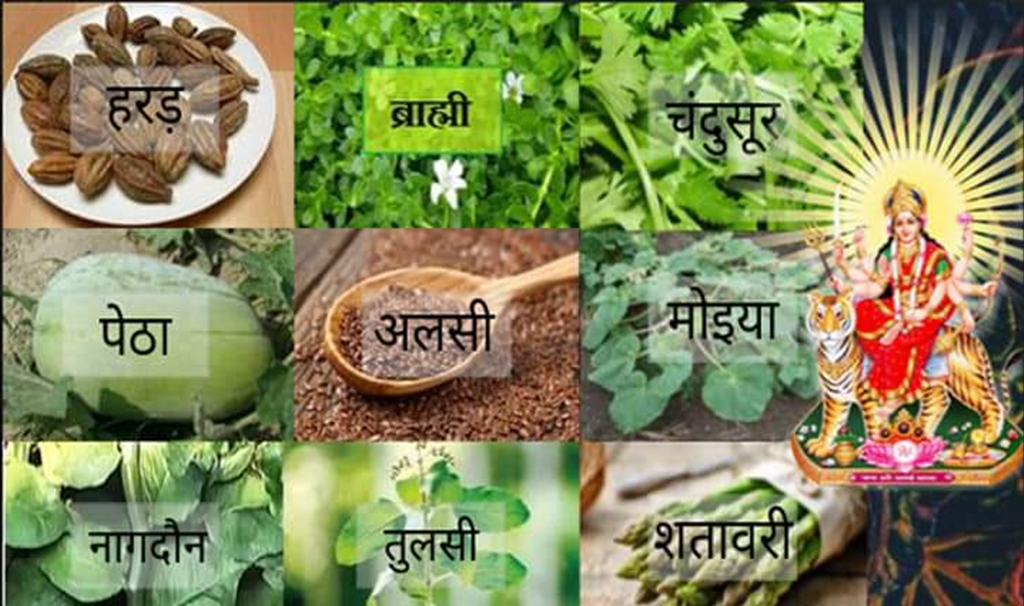
- The first form of Goddess Durga is Shailputri and the herb associated is Haritaki. It is one of the most beneficial herbs in Ayurveda. Haritaki improves the digestive system and is an excellent liver tonic.
- The second form of Goddess Brahmacharini and it is situated in herb Brahmi. Brahmi is an excellent memory tonic. Brahmi is also used to improve memory or memory health, as well as to maintain good voice. She is also known as Saraswati.
- The third form of Goddess Durga is Chandraghanta which is related to herb Chandrashur. It reduces weight and keeps the body fit which is a favorite among the youth of today.
- The fourth form, Kushmanda is seated in Kushmanda, Petha or Kohala. Not only is Kohala a blood purifier, but it also has a good effect on mental weakness.
- The fifth form, Skandamata, appears seated in the herb Jawas. Jawas is not only useful in heart diseases but also works well on three doshas.
- The sixth form, Katyayani, is connected with herb Mahua / Moiya. It works best on three doshas.
- The seventh form is Kalaratri which is seen seated in the herb Nagdaun / Nagdaman / Nagdavana, which works on headache and all disorders of the head.
- The eighth form is Mahagauri, who appears seated in the herb Tulsi. Holy Basil is also good for heart health and boosts immunity.
- The ninth form is Siddhidatri, who appears seated in the herb Shatavari (asparagus). It is considered very important in Ayurveda. It imparts strength to women and considered very useful in mental health and orientation.
On the occasion of Navaratri, it is again worth mentioning that all the festivals of Indian culture are associated with nature, daily routine and herbal medicines. Ayurbreeze Botanicals makes ayurvedic products naturally using these herbs. No chemicals are used. It helps in maintaining a healthy lifestyle for women and also helps in keeping the entire family healthy from the youngest to the oldest.
Anuja Kulkarni Director, Ayurbreeze Botanicals